
The Relationship Loop: Why Some Writers Convert Readers and Others Just Accumulate Them
Let's build a loop that builds relationships


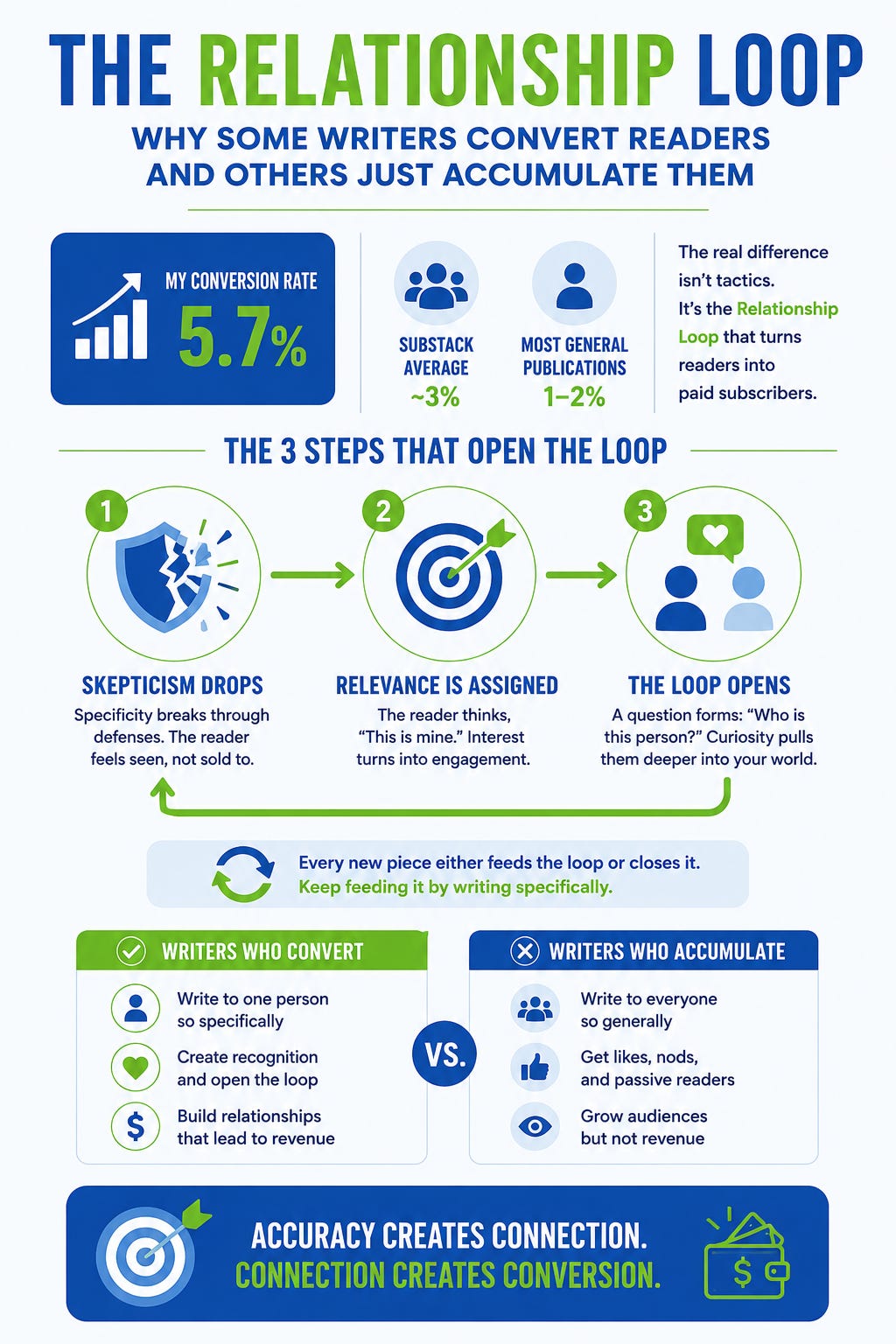
My conversion rate is 5.7%.
The Substack average is around 3%. Most general-audience publications sit at 1-2%.
For a long time I assumed the gap came down to content quality or posting frequency or the strength of my CTAs. I kept optimizing those things and the rate kept improving.
But when I started looking closer at what was actually moving paid conversions, the answer was simpler than I realized. I made a point to personally engage with free subscribers, showing up in their comment sections, DMing them when they joined, responding to every comment they left on my work. Over time that engagement made them comfortable enough with me to upgrade.
What I eventually realized is that I was doing something specific at the moment of first contact with a new reader, and continuing to do it consistently afterward, that most writers skip entirely. Something that happens before the CTA, before the content strategy, before any of the tactical work I teach.
Here’s what it is.
Here’s How it Starts
When someone encounters your Substack for the first time, whether through a Note, a post, or your profile, their brain is running a rapid evaluation. Even if they don’t realize it.
The evaluation has one question at its center:
Is this for me?
Not “is this good?” Not “is this person credible?” Not “is this topic interesting in a general sense?”
Is this specifically, personally, unmistakably for me?
Most writers never trigger a yes to that question. Their content is good but general. Relatable but broad. Interesting but not personal. The reader nods along, maybe likes the post, and moves on. They’ve consumed something. They haven’t felt anything.
The writers who convert, really convert, at rates that move revenue, trigger something different. When the right reader encounters their work, something shifts. The nod becomes a stop. The passive consumption becomes active engagement. The reader doesn’t just read the post. They feel recognized by it.
That feeling of recognition is the beginning of what I call the Relationship Loop. And it’s the mechanism that explains almost every paid conversion I’ve ever made or watched happen.
How the Relationship Loop Opens
The Relationship Loop has three steps and they happen in rapid sequence, fast enough that the reader experiences them as a single emotional event rather than a process.
Step 1: Skepticism drops.
The default posture most people bring to content online is mild suspicion. They’ve been marketed to, manipulated, and over-promised enough times to develop a layer of protective cynicism. Most content triggers that layer, the reader scans it from behind a glass wall, assessing whether it’s worth their attention.
But occasionally something breaks through. Not because it’s louder or more impressive. Because it’s accurate. Specifically, unusually, almost uncomfortably accurate about something the reader has actually experienced.
When that happens, the defensive layer dissolves. The glass wall disappears. The reader is no longer assessing, they’re absorbing. And everything that follows lands differently than it would have if the skepticism had stayed up.
This is why specificity is the most powerful tool in a writer’s arsenal. Vague recognition (”building on Substack is hard”) produces a nod. Specific recognition (”you published something last Tuesday that you were proud of, and by Thursday it had eleven likes and no comments, and you told yourself it didn’t bother you”) produces a stop. The specific version doesn’t just describe a situation — it describes their situation. And that accuracy is what drops the wall.
Step 2: Relevance is assigned.
Once skepticism drops, the brain makes a rapid reassessment. The reader moves from “is this worth my attention?” to something more personal: “does this apply to me specifically?”
This distinction matters enormously. Content can be broadly interesting without being personally relevant. Interesting content gets consumed and forgotten. Relevant content gets acted on.
The writers who convert well write content that passes this relevance test not because it’s on a popular topic but because it describes a specific person’s specific situation with enough accuracy that the reader thinks — this isn’t just interesting. This is mine. This was written for someone exactly like me.
That feeling of personal relevance is what makes a reader click your profile. Read another post. Return tomorrow. It’s the difference between “I liked that” and “I need more of this.”
Step 3: The relationship loop opens.
This is the step most writers never reach, and it’s the one that makes conversion possible.
When skepticism has dropped and relevance has been assigned, something happens in the reader that is genuinely different from ordinary content consumption. A question forms. Not “what do I think about this?” but something more relational: Who is this person? What else do they know? Where do they go deeper?
That question, that pull toward the person rather than just the content, is the relationship loop opening. It’s the moment where the reader stops being a passive audience and starts being a potential subscriber.
I call it a loop because it doesn’t resolve on its own. The brain has opened a question about a person and it will continue looking for the answer until it finds it or loses interest. Every new piece of content from that writer either feeds the loop or closes it. A new post that produces recognition feeds it, the reader goes deeper into your world. A post that feels generic or off-topic closes it, the reader drifts back to passive consumption or disappears entirely.
The writers who convert at high rates are the ones who keep feeding the loop. Not by posting more. By posting more specifically.
Why Most Creators Never Open the Relationship Loop
Here’s the part that is most counterintuitive.
Most writers are trying to open the relationship loop with the wrong tool.
They use expertise. They demonstrate what they know, how credible they are, how much they’ve studied and applied. They show their results and their frameworks and their systems.
And none of it opens the loop.
Not because expertise is irrelevant, it becomes relevant once the loop is open. But expertise alone doesn’t drop the wall. It doesn’t assign personal relevance. It doesn’t create the pull toward the person that makes the reader want more.
What opens the loop is recognition. The reader has to feel seen before they’ll feel curious about the person doing the seeing.
This is why the writers who convert at the highest rates are almost never the most credentialed ones. They’re the most specific ones. The ones who describe their reader’s experience with enough accuracy that the reader stops and thinks, how does this person know that?
That question is the relationship loop opening.
And it only gets asked when the content is specific enough to produce genuine recognition rather than generic agreement.
What This Means in Practice
The loop can open anywhere; a Note, a post, a bio, a welcome email. It can open through tactical content if that content describes your reader’s specific situation accurately. It can open through a personal story if the story reflects an experience your reader has lived.
What it cannot open through is content designed to reach as many people as possible. Maximum reach requires maximum generality. Maximum generality prevents specificity. And specificity is the only key that opens the loop.
This is why some writers with a fraction of your subscriber count convert at three times your rate. They’re not ‘better’ creators in any traditional sense. They write to one person so specifically that every person who fits that description feels personally addressed.
And here is the harsh reality: every piece of content you write that is designed to appeal to everyone is a piece of content that will open the loop for almost no one.
The narrower you write, the more deeply the right reader feels recognized. The more deeply they feel recognized, the faster skepticism drops. The faster skepticism drops, the more quickly relevance is assigned. The more quickly relevance is assigned, the sooner the loop opens.
And an open loop is a subscriber in formation.
Here’s the Question to Ask Before You Publish Anything
Before your next post, your next Note, your next bio update, ask one question:
Will the right person feel specifically seen by this, or will everyone feel vaguely addressed?
If the answer is vague, the content won’t open the loop. It might get likes. It might get some traffic. But it won’t create the pull toward you as a person that makes someone want to know what else you know, read what else you’ve written, and eventually decide that being inside your paid community is where they belong.
Accumulating readers is easy. You do it by writing broadly about topics that interest a lot of people.
Converting readers is different. You do it by writing specifically enough that the right reader feels seen, and the moment they feel seen, a loop opens that keeps pulling them closer until they’re ready to pay.
The difference between a Substack that grows and one that compounds is the difference between content that informs and content that opens loops.
Write the kind that opens the loop.
This post was designed with Mia Kiraki 🎭’s MINT skill, you can learn more here.
This is the mechanism at the center of everything inside Backstage Pass, how to write specifically enough to open the relationship loop, how to feed it once it’s open, and how to recognize when a reader is close enough to convert that a single well-timed post will tip them over. If you want to go deeper, join us.
The upgrade isn’t the end of our relationship. It’s the start.
Behind the Bestseller: Mia Kiraki

Sometimes you can tell that a creator is destined to be a ‘big deal’ the first time you see their Substack.
Appreciate this post as giving permission to talk about the things that specifically interest you as a writer without feeling like you need to be a credentialed expert.
My favorite articles to write are the ones where I barely use AI because it comes from experience. AI can’t fake experience and I feel like that makes it more personal.
However, I did just write an article on IT asset management so maybe five people are all in on that.
Super insightful! :) I think there are two kinds of Substack content here. Some is highly practical, built around a problem, and valuable because the reader wants access to the information itself. The relationship with the writer matters far less.
Then there’s the kind where the work depends on the person behind it, because their perspective, judgment, and way of seeing are part of what you’re subscribing to. That’s where this loop becomes ESPECIALLY important. And this plays a huge role on churn too!
And, very honestly, our friendship was what moved the needle for me when I upgraded. Thank you for the MINT shoutout too ❤️