
What Substack is Telling Us About How Its Algorithm Works
It's totally backwards from what you are used to

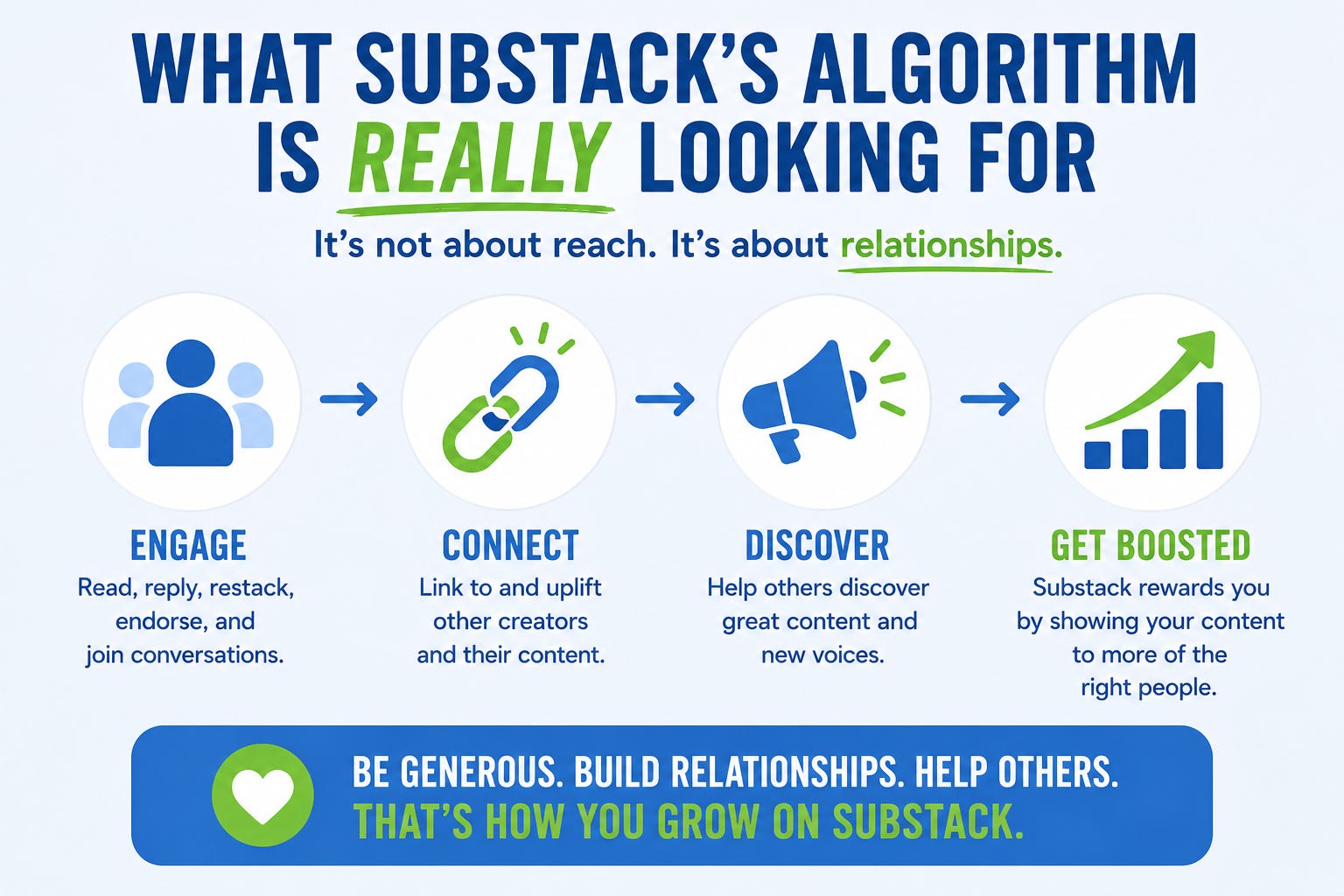
Late last year, I wrote a post for Paid subscribers detailing some of the main ways that Substack’s algorithm can work to categorize and boost your content. If you are in the Paid community, it’s worth a second look:

The reason why a lot of people struggle to grow on Substack is because they treat the algo here as being the same on every other social media sites.
Other sites want you to doomscroll. They want you to endlessly consume content in the form of posts, reels and video. First they start out trying to lock you into one topic, then once they figure out what topic you are interested in, they start serving you more ‘elicit’ forms of that content. Designed to keep you scrolling.
Because the goal for those other sites is to keep you on the site as long as possible. They will then use that information to charge more for advertisers who want to see that users are staying on the sites they buy ads on.
But remember, Substack doesn’t have ads in its feed. Substack makes money off Paid subscriptions. In other words, Substack makes money when you make money.
And Substack has figured out that one of the best ways for you to make money is by building relationships with others. When you build relationships, that leads to trust, which leads to sales.
Substack has determined that those relationships are more likely if we are constantly interacting with each other. So Substack’s algo is designed to have us seeing content by people who we are already engaging with, and who cover similar topics as we do.
This is why I always advise you to spend your time engaging with other people’s content. Because I knew that it would help you build those valuable relationships, but I also sensed that Substack’s algo would reward you for engaging.
As it turns out, Substack’s team has confirmed this is the case.
In an event last year, the team was asked how our feeds are organized:
“It ultimately boils down to what the objective function of our feed is. The goal is to get people to discover, subscribe, and ideally pay. That’s how we built the feed and how we continue to iterate to make sure that we’re driving subscriptions up.”
I thought Casandra Campbell had some great thoughts on this last week:
Reply, restack, and endorse other writers, especially ones you genuinely admire. Substack found that signal-boosting other publishers and joining the wider conversation are both linked to noticeable growth, which makes sense once you know that engagement is how the system maps audiences together. Highlight people whose work you respect, and don’t be shy about sharing when they do the same for you.
In short, if you act in a way that benefits Substack, then Substack will boost your content. It’s as simple as that.
Here’s an example: Let’s say you join Substack today. You start reading other substacks, and you see a lot of advice saying you should write Notes to grow.
Cool, you go write Notes. 3 a day for the next week. Sharing whatever thought that comes into your head.
This content does not help Substack. At all. Sooooo…Substack likely won’t boost it.
On the other hand, let’s say you spend your second week here writing Notes that share links to some of the interesting posts and Note you read in your first week here.
Suddenly…Substack’s algo starts paying attention. Why? Because by writing Notes that link to other people and their content, you are helping Substack users DISCOVER other people. You are moving Substack users closer to becoming Paying subscribers for these publications.
Substack likes it when you do that, so the algorithm boosts your content as a result.
Want to a real world example of this? Every week or two, I will write a Note sharing some of the new friends I have made on Substack, and I will encourage everyone to follow them, then ask everyone to tell me who are some friends they have made I should follow. I started doing this as a networking tool, to help promote my new friends and expand my network.
But one day, I decided to check the stats on these notes. Look at this:
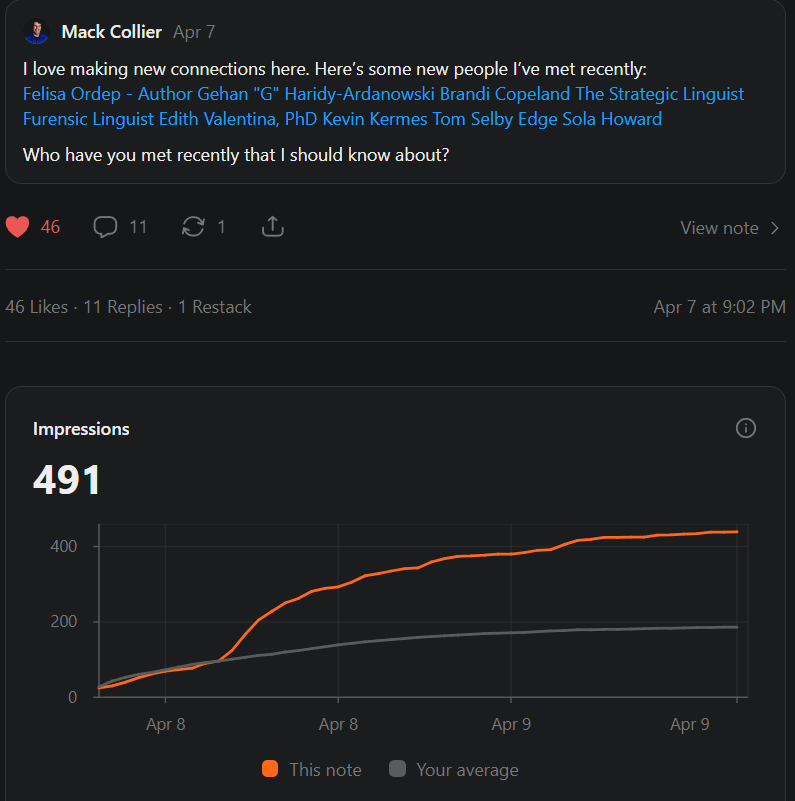
Notice views for this Note were right along my average for the first few hours. Then suddenly, views took off like a rocket. What happened? My guess is the algo woke up and started boosting the Note.
Here’s another one:
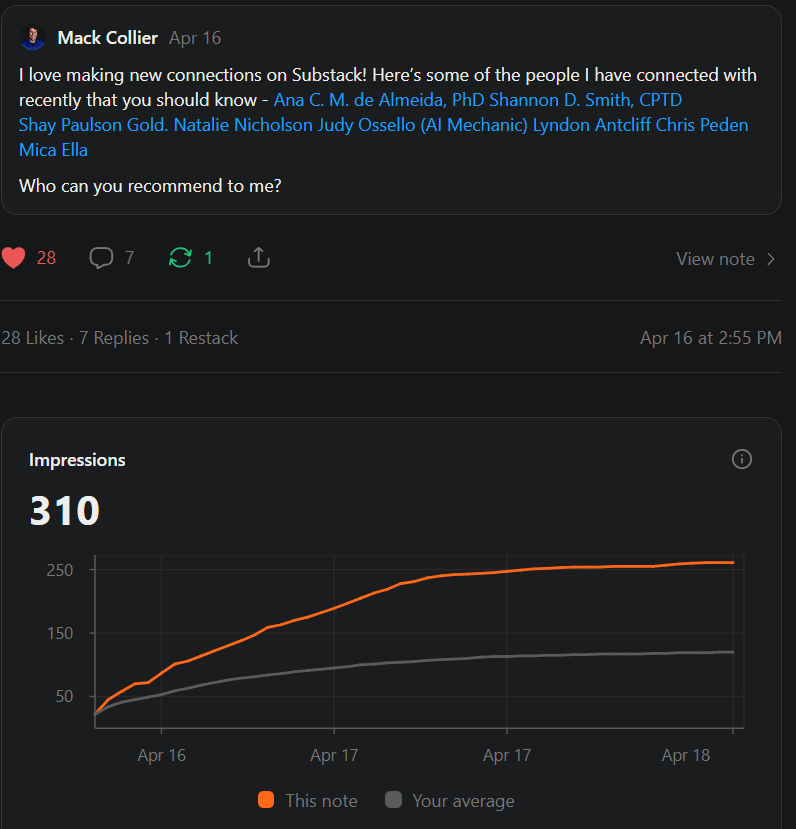
Views of this Note well above average. Both Notes followed the same format, both Notes seriously outperformed.
I started checking all the Notes I had written around this time. Every single one that did better than average had one thing in common: They all linked out to either another Substack user account, or publication. ANY link at all within the Substack ecosystem (other than my own content) resulted in higher than average views.
The Notes where I didn’t have a link or linked to my own content? Almost always had average or below average views.
And here’s the thing, I wasn’t trying to game the algorithm when I wrote those Notes. I was just doing what felt right: telling people about creators I had recently met and I wanted to introduce them to others.
The algorithm rewarded me for it anyway.
That’s the part most people miss. You don’t have to choose between being genuine and being strategic on Substack. The platform has been designed so that those two things point in the same direction.
What Can You Learn From This?
Substack’s algo wants you in ‘discovery’ mode. It wants you to create Notes in particular that link out to OTHER people and OTHER content besides your own.
This type of content gives you an algorithmic boost, but it also helps you build connections with more people here.
If you think about it, Substack has created a system where you will be boosted for…making friends.
Not a bad deal.
Should you stop writing Notes where all you do is promote yourself and your content? Of course not. But you should view these self-promotional Notes as a tool in your toolbox, not the whole damn toolbox.
The real gains live in writing Notes that promote others.
You can experiment with this yourself. Take the last 5 Notes you wrote where you shared your latest post or your latest off-the-top-of-your-head idea, and compare it to the last 5 Notes you wrote where you tagged someone else.
My guess is when you click View Stats you will see that the Notes where you tagged others outperformed the self-promotional Notes. Likely by a wide margin.
Want to test if you get an algorithmic boost from engaging with others? Restack this post with a Note explaining what you liked about the post. Then track the views you get for the Note. You will see that views for the Note with the restack should have more views than your average Note does. Try it now and see:
The Bigger Picture
Most people come to Substack thinking about growth the way they think about every other platform: post more, reach more people, gain more followers.
Substack’s algorithm is built on a completely different premise.
It doesn’t want you to reach more people. It wants you to connect with the right people, and then help those people discover others they’ll connect with too. The algorithm is essentially asking: are you making Substack a better place to find great content? If yes, we’ll boost you. If no, you’re on your own.
This changes the entire frame.
Instead of asking “how do I get more views?” ask “how do I help more people discover content they’ll love?” Those questions lead to completely different behavior. The first leads to self-promotional Notes that perform at or below average. The second leads to Notes that link out, spotlight others, and map audiences together, and get algorithmically boosted as a result.
Substack has essentially built a system where being a good citizen of the community is the highest-leverage growth strategy available to you.
Think about that for a second. The platform is rewarding generosity. Not gaming. Not hacking. Not posting at optimal times or using the right hashtags or engineering the perfect hook.
Generosity.
Writing Notes that say “hey, you should check out this person”, that’s what the algorithm boosts. Building relationships that cause other writers to say “hey, you should check out Mack”, that’s what creates the audience overlap that compounds over time.
Substack has essentially built a system where being a good citizen of the community is the highest-leverage growth strategy available to you.
You don’t have to outsmart the algorithm. You just have to be the kind of creator Substack wants more of.
Fortunately, that’s also the kind of creator your readers want more of.
Start there.
Backstage Pass is more than a name. It’s an invitation.
An invitation to curious people who like to peek behind the curtain. The people who say “Show me how you did that.”
These are the people who should be in the Backstage Pass community.
In August of 2025, I had 7 paid subscribers and a 0.5% conversion rate.
At that point I made two decisions: First, I was going to build a system to increase my conversion rate and my revenue. Second, I was going to share everything I learned with my paid subscribers.
The people like me. The ones who want to build something instead of being handed something.
Join us?
I Can Tell in Under a Minute If Your Substack is Successful

Let’s say someone says to you “I’m going to show you a car. As soon as you see the car, tell me immediately, your gut reaction, is it a fast car?”
Support to another is although an uplift to yourself, we are the world.
Thanks for this article. Very helpful and I always appreciate what you share.