
I've Been Spying On How You Use Substack, Here's What I Saw
The same patterns, good and bad, repeat themselves


If your Substack isn’t growing right now, I probably know why.
For the last several months I’ve been systematically tracking dozens of Substack creators; their activity, their engagement, their subscriber counts. A pattern emerged almost immediately. The same traits show up in everyone who is growing. The same traits show up in everyone who isn’t.
The hard part isn’t identifying the pattern. The hard part is that most people who are stuck already suspect what the problem is — they just haven’t wanted to look at it directly.
Let’s look at it directly.
Every week I track dozens of substackers across multiple groups and interests. Almost immediately, a pattern developed and two things became apparent:
1 - Some people were growing, and some people were not
2 - It became obvious why some people were growing, and obvious why some were not
I want to break down what I’ve learned so you can decide which group you are in, and what you need to do to move to the growth group.
I Spy on Other Substackers. A lot.
Well…maybe ‘spy’ isn’t the right word. I have several groups of substackers who I like to keep up with:
My Paid subscribers
Free subscribers who I believe may be interested in upgrading to Paid
Friends
People I want to stay in touch with
Why do I do this? Because I want an easy way to stay in touch with the people in each group. A huge component of success on Substack is about building relationships, and it’s tough to build relationships with people who you don’t know. So I like to keep up with the people here who I want to have a relationship with. It helps me understand who they are, what their challenges are, where they are seeing success.
Simply put, it helps me better serve them as friends and partners.
Hi! I’m Mack and I show you that growth on Substack is actually achievable. Every post is designed to teach you in plain terms, how to build a sustainable business here that you will love building. I’ve already done it, which proves you can too!
I’ve noticed that everyone I follow falls into one of two groups:
They are growing
They aren’t growing
What I mean by growth in this case is their number of free subscribers is increasing. That’s very easy to track for the people who list their number of subscribers on their profile. For the ones who aren’t, I can still get a general sense of whether they are moving forward or backwards.
Let’s go through both groups and talk about what I see:
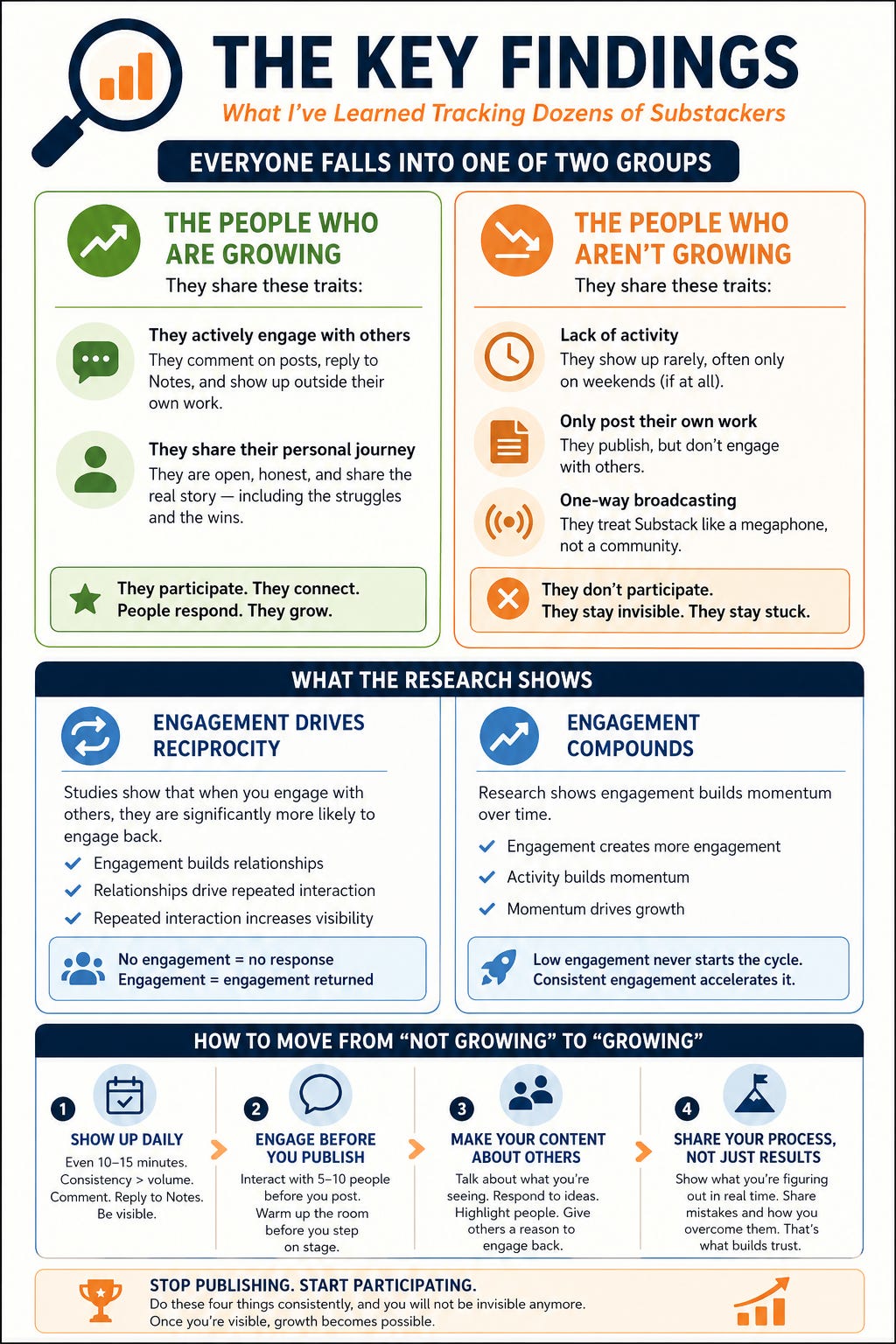
The People Who Are Growing Are Doing This
There are a few common traits I’ve noticed from the people who are growing.
Perhaps the biggest indicator of growth is how active are they outside their own content. The people who are growing the fastest are the ones who are actively commenting on other people’s content.
Obviously, being active more often counts, but all other things being equal, growth comes from being active on other people’s content.
Here’s an example: There are two people who I am tracking, one is growing very slowly, the other isn’t growing at all. Both of them post about 2-3 times a month.
The difference? The first person posts about other people, the second posts about themselves. Both of them show up 2-3 times a month, but the first person is showing slight growth, because what little activity they have, is focused on others. That gives people a reason to engage with them, and they are growing. The second person rarely shows up and when they do, it’s to promote themselves. They are literally on an island.
So volume of activity is a strong indicator of growth if the activity is aimed at engaging with others. That is the key, and Substack has confirmed that it’s algorithm rewards creators who engage with others.

Past engaging with other people’s content, I believe the biggest indicator of growth is creator’s who are sharing their personal journey. Here’s two examples:
Kay Walten is sharing personal stories from her experience living and building a career in hospitality in Mexico. This is a recent shift she made, to start infusing more personal stories from her own life into her content. It’s leading to a nice surge in her growth because we all want to hear these personal stories, they make the creator more interesting and relatable.
Another example is Kim Doyal. Kim is making a name for herself in the very crowded AI space by sharing what she is learning, as she learns it. Let’s be honest, understanding AI right now can be pretty overwhelming. Kim is sharing the good and bad about her journey. The ‘hey look at this cool thing I discovered!’ one day, then ‘this doesn’t make sense at all’ the next. It’s personal, and it mirrors the frustrations that a lot of us are having with AI right now.
The bottom line is the people who are growing are engaging with others, and are sharing their personal stories. They are being open and honest. And people are responding. Which is why they are growing.
The People Who Aren’t Growing Are Doing This
The people who aren’t growing also have very clear traits.
Most notably is a lack of activity. Look, I get it. Many of you are doing Substack on the side as you work full-time. That means Substack gets relegated to an hour or so on the weekend. At best. I totally understand this.
The reality is, your Substack’s growth is greatly dependent on how much time you can devote to it.
The people who aren’t growing also have very clear traits. Most notably…they’re not very active.
And when they are active, it’s usually just to post their own work.
Here’s the problem with that:
Growth on Substack isn’t just about publishing, it’s about participation.
There’s actual research behind this. Studies show that engagement on social platforms is driven by reciprocity. When you interact with others, they are significantly more likely to interact back.
What the research says about engagement and growth
A controlled study on social media behavior found that people consistently reciprocate engagement. When someone receives a like or interaction, they are significantly more likely to return that engagement in the future.
This effect is especially strong among weaker connections (people who don’t know each other well). In those cases, engagement becomes a simple exchange:
no interaction → no response
interaction → interaction returned
The study also found that engagement triggers positive emotional responses (like excitement), which increases the likelihood of continued interaction over time.
In plain terms:
Engagement builds relationships
Relationships drive repeated interaction
Repeated interaction increases visibility
And visibility is what leads to growth.
If you’re not engaging with others, you’re not just missing opportunities—you’re removing the natural feedback loop that drives attention, connection, and ultimately, subscribers.
And it doesn’t stop there.
Engagement compounds.
Another study found that the more people engage, the more future engagement they generate over time:
What the research says about engagement compounding
Research on social media behavior shows that engagement is not a one-time action, it builds momentum over time. When users actively interact (commenting, replying, participating), they increase the likelihood of future interactions, both from themselves and others.
This creates a compounding effect: early engagement leads to more visibility, which leads to more interaction, which then reinforces continued engagement. Over time, this cycle strengthens relationships, increases reach, and improves overall outcomes tied to visibility and connection.
In simple terms:
Engagement creates more engagement
Activity builds momentum
Momentum drives growth
When engagement is low or inconsistent, this cycle never starts—making growth significantly slower or nonexistent.
Which means if you’re not engaging…
You’re not just slowing your growth.
You’re shutting off the engine entirely.
On Substack, this shows up in a few ways:
People who don’t post consistently struggle to stay top of mind
People who post but don’t engage rarely get discovered
People who treat Substack like a one-way broadcast stay stuck
It’s not a content problem.
It’s a participation problem.
If you aren’t growing on Substack right now, ask yourself this: Am I actually showing up, or am I just publishing?
How to Move From “Not Growing” to “Growing”
If you’re in the “not growing” group right now, the solution isn’t complicated.
But it does require a shift.
You have to stop thinking like a publisher…and start acting like a participant.
Re-read that line until it sinks in. The creators I track who aren’t growing all act like publishers. They create and publish content. They never leave their own feed they never engage with others. Which is why no one engages with them either.
The people who are growing are participating. They create, but they also engage with what others have created. That’s the shift.
If you want to make a similar shift, here’s where I would start:
Show up daily (even if it’s just 10–15 minutes)
You don’t need hours. But you do need consistency. If you only have one hour a week split it among 4-5 days. Substack’s algo will boost your content more if it seems you active on the platform for 5 days a week versus one.
Comment on posts. Reply to Notes. Be visible.Engage before you publish
Before you hit “post” on anything, go interact with 5–10 people first.
Warm up the room before you step on stage. Susbtack’s algo likes to see this.Make your content about others, not just you
Talk about what you’re seeing. Respond to ideas. Highlight people. I’ve started tracking the impressions on my own Notes. The Notes that do the best for me are the ones where I highlight others.
Give others a reason to engage back.Share your process, not just your conclusions
Don’t just teach. Show what you’re figuring out in real time. And don’t be afraid to show your mistakes. Showing mistakes is the quickest way to build trust. Especially if you show the mistakes as they happen, then later show how you overcame the mistakes. That’s what people connect with.
If you do just these four things consistently, you will not be invisible anymore.
And once you’re not invisible…growth becomes possible.
Building growth is exactly what I focus on with my Paid subscribers.
We go deeper on what to do, how to do it, and how to build real momentum here without guessing.
If you’re serious about growing on Substack, come join us.
Let’s get you into the group that’s actually moving forward.
Bonus: Now through the end of May, if you upgrade to Paid at either the monthly or annual level, you will receive a free copy of The 5% Conversion System. This includes all the frameworks, exercises, prompts and scripts I have used to boost my revenue by over 1,000% and 10X my conversion rate over just the last 8 months.
This free offer ends on Sunday. On Monday, The 5% Conversion System goes to my Gumroad store for $99. Upgrade today, and it’s yours for free!
I love that you picked two of my favorite people to highlight - the most genuine and badass. But this whole article reminds me of a saying - Fast is for learning, slow is for growth. We can come, publish and move on or we can linger, connect and have some fun. And your finding support the slow and fun part.
Omg wow you mentioned me! Thank you Mack! As I started reading your post I was thinking geez what am I doing wrong. Maybe I need Mack to look at my stuff. Then I see my name along side with Kim. Mil gracias!! 🙏