
Here's Why Most Substack Growth Advice Makes You Miserable
Don't follow the rules and leave yourself behind


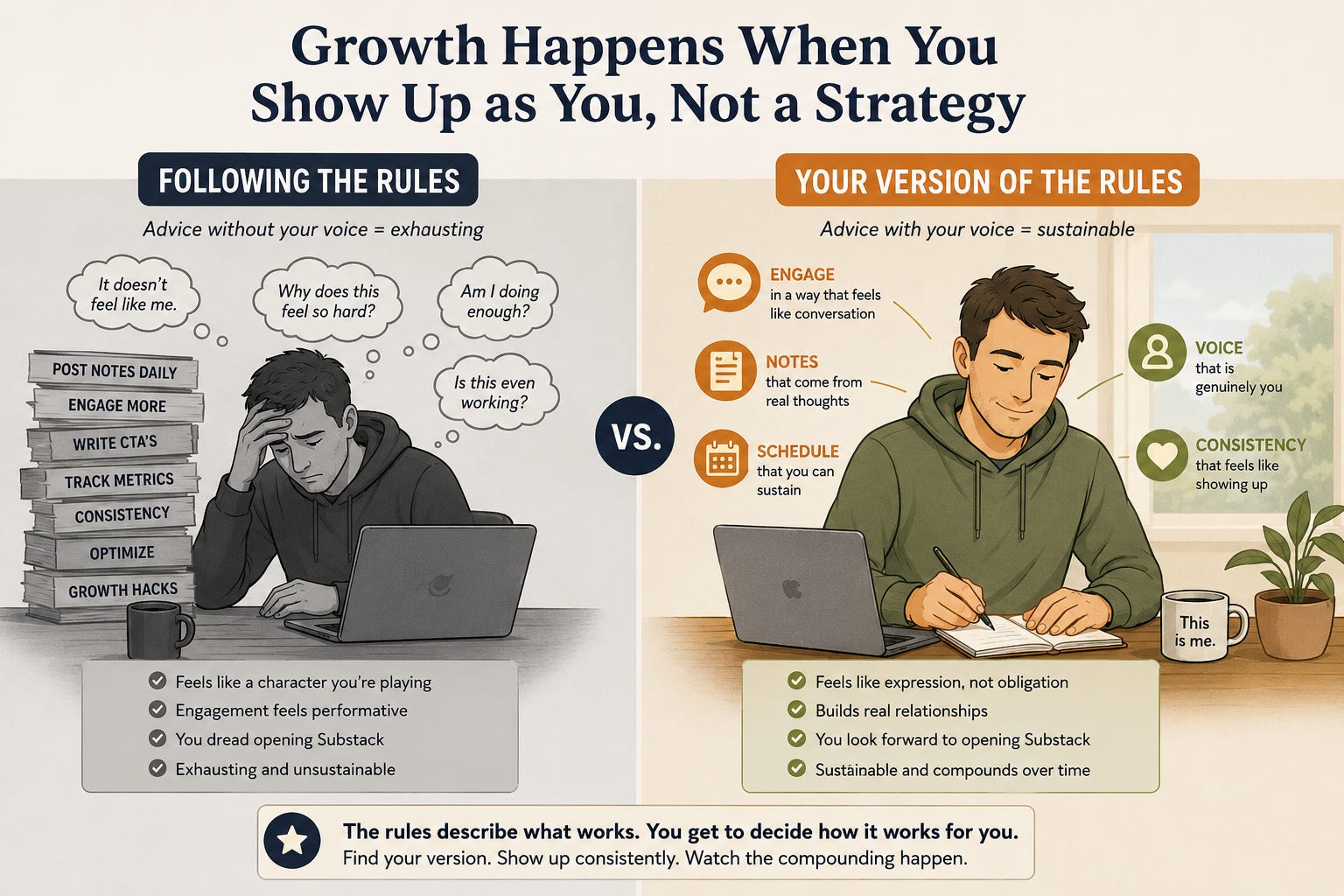
You’ve been following all the ‘rules’.
You’re posting Notes consistently. You’re engaging in other people’s comment sections. You’re publishing on a schedule. You’re writing CTAs. You’re tracking your open rates and your subscriber count and your conversion rate.
You’re following the advice. All of it. Even when it doesn’t make sense, you do it anyway.
And somewhere in the last few weeks or months, you’ve started to dread opening Substack.
Not because it isn’t working. Well…maybe a little. But it’s more about how the optimized, advice-following, metric-watching version of you that’s following all the ‘rules’…that’s not really you. It feels like a character you’re playing. A content creator. A growth-focused newsletter operator.
Somewhere along the way to optimizing your Substack, we left the human being behind.
Let’s see if we can find our way back to where you can see yourself in your work again.
The Problem With “The Rules”
Substack growth advice is almost always correct in its conclusions. Engage with others and you’ll get engagement back. Write consistently and you’ll build an audience. Use strong CTAs and you’ll convert more paid subscribers. Post Notes regularly and the algorithm will reward you.
All true. All proven. All worth following.
The problem isn’t the rules. It’s that most growth advice describes what to do without leaving any room for how you specifically do it. And the how is where your voice lives.
When someone tells you to engage in other people’s comment sections, they’re giving you a destination. They’re not telling you to write comments that sound like everyone else’s comments. They’re not telling you to engage with topics that don’t interest you. They’re not telling you to show up in conversations where you have nothing genuine to add.
But that’s often what happens. The writer who internalizes “I need to comment more” starts leaving comments everywhere, on everything, whether or not they have something real to say. The comments feel hollow. The engagement feels performative. The writer knows it. The people receiving the comments probably sense it too.
And then the writer wonders why the engagement isn’t converting into relationships.
It’s not a volume problem. It’s an authenticity problem. And authenticity problems masquerading as volume problems are exhausting, because the harder you work the worse you feel.
Authenticity problems masquerading as volume problems are exhausting, because the harder you work the worse you feel.
What Nobody Tells You About Growth Systems
Here’s the thing about growth systems that most people teaching them don’t say out loud: the best system is the one you’ll actually maintain.
A perfect system you abandon in six weeks produces worse results than an imperfect system you sustain for two years. Consistency is the variable that matters most in the long run, and consistency requires that the work feel like something you can keep doing, not something you’re enduring.
This is why two writers can follow identical advice and produce completely different results. One of them found the version of the advice that fits their voice and their energy and their particular way of showing up in the world. The other is doing a faithful impression of what the advice describes. Both are “following the rules.” Only one of them is building something sustainable.
The question worth asking isn’t “am I following the advice correctly?” It’s “have I found my version of this advice?”
Those are different questions. And most writers never ask the second one.
You are the person doing the work. If you aren’t enjoying it, then you won’t maintain it or see the results you want.
Finding Your Version
Let me be specific about what this looks like in practice, because “be authentic” is advice so vague it’s nearly useless.
Engagement. The rule is engage with others consistently. Your version of that rule might be five thoughtful comments a day, or it might be two genuinely extended conversations a week. Both are engagement. One of them will feel like showing up. The other will feel like punching a clock. Figure out which one you can sustain and do that one.
Notes. The rule is post Notes regularly. Your version might be tactical frameworks, or it might be personal observations, or it might be reactions to things you’re reading and thinking about. All of these work. The one that works best for you is the one that comes from something real, not the one that matches the format you saw perform well on someone else’s account.
Publishing schedule. The rule is consistency. Your version might be twice a week, or it might be once a week with a short mid-week Note. The specific cadence matters far less than the fact that your readers can predict when you’ll show up. Pick the schedule you can sustain in a bad week, not the one that’s optimal in a good one.
Voice. This one isn’t negotiable. There is no “correct” voice for Substack. There are voices that are genuinely yours and voices that are approximations of what you think a Substack writer should sound like. Readers can feel the difference immediately even if they can’t articulate it. The approximation is what makes the work feel hollow. The real thing is what makes people come back.
The Compromise That Isn’t Actually a Compromise
Here’s the reframe I want to offer: you don’t have to choose between following the rules and being true to yourself. That’s a false choice.
The rules describe the shape of what works. They don’t dictate the substance. Engagement works, but your engagement doesn’t have to look like anyone else’s. Notes work, but your Notes don’t have to sound like anyone else’s. Consistency works, but your schedule doesn’t have to match anyone else’s.
What you’re looking for isn’t a way to get out of doing the work. You’re looking for a way to do the work that feels like expression rather than obligation. That distinction matters enormously for sustainability, and sustainability is what produces compounding results over time.
The writers I’ve watched build something real on Substack share one trait more than any other. Not the best hooks. Not the most tactical Notes. Not the highest posting frequency.
They found their version of the platform. The way of showing up that is genuinely theirs. And then they showed up that way, consistently, for long enough that the compounding kicked in.
That’s not a rejection of growth advice. It’s the fullest possible expression of it.
What you’re looking for isn’t a way to get out of doing the work. You’re looking for a way to do the work that feels like expression rather than obligation.
The Question to Ask Yourself Today
Not “am I following the rules?” You probably are.
Not “am I working hard enough?” You probably are.
This one: “Does the way I’m showing up on Substack feel like me?”
If the answer is yes, keep going. The discomfort you’re feeling is probably just the long middle of building something, which is uncomfortable for everyone.
If the answer is no, something needs to change. Not necessarily what you’re doing. How you’re doing it. Find the version of the engagement that feels like genuine conversation rather than networking. Find the version of the Notes that feels like thinking out loud rather than content production. Find the version of the schedule that feels like showing up rather than checking boxes.
The rules are real. The results they produce are real. But the rules were built to describe what works, not to describe who you have to become in order to make them work.
You don’t have to become someone else to grow here.
You just have to find the version of this that’s actually you.
And then do that, consistently, for longer than feels comfortable.
That’s it. That’s the whole system.
This is what we work through inside Backstage Pass — not just the tactics, but finding the version of those tactics that fits your voice, your energy, and the specific Substack you’re trying to build. If you’re tired of following advice that feels like wearing someone else’s clothes, come build it your way — with someone who will show up alongside you.
The upgrade isn’t the end of our relationship. It’s the start.
The ONE Strategy That's Fueling My Paid Growth More Than Anything Else

It works amazingly well for me, and I know many of you don’t want to do it.
"Authenticity problems masquerading as volume problems are exhausting, because the harder you work the worse you feel."
This line really made me pause, because it’s true. I’ve been trying to follow all the rules: post, comment, schedule, engage. Somewhere along the way, I lost sight of why I started.
"Does the way I'm showing up feel like me?" That was the question I needed to see tonight. Not "am I doing it right?" but "am I still here?"
Thank you for reminding me that it’s okay to stop performing and just be myself.
Best advice on Substack right here, my friend. You are the GOAT!