
Churn Is Quietly Killing Your Substack. Here's How to Fight Back.
The secret to reducing churn and how to use it

I should have 68 Paid subscribers today.
At that pace, I’d be on track to hit 100 Paid subscribers, and the Bestseller Badge, sometime in June.
Instead I now have 59 Paid subscribers. And that means I likely won’t get my Bestseller Badge till August at the earliest.
The difference is 9 subscribers.
Churn happened.
And for a while, I didn’t have a system to stop it.
In this post I’m going to show you the system I built to address churn and how you can build your own.
Because I don’t want to lose Paid subscribers. And I don’t want you to either.
Why Subscriber Churn is More Expensive Than it Looks
Before we talk about how to fix churn, let’s talk about what it is and its actually cost. Because the number in your dashboard understates the real damage.
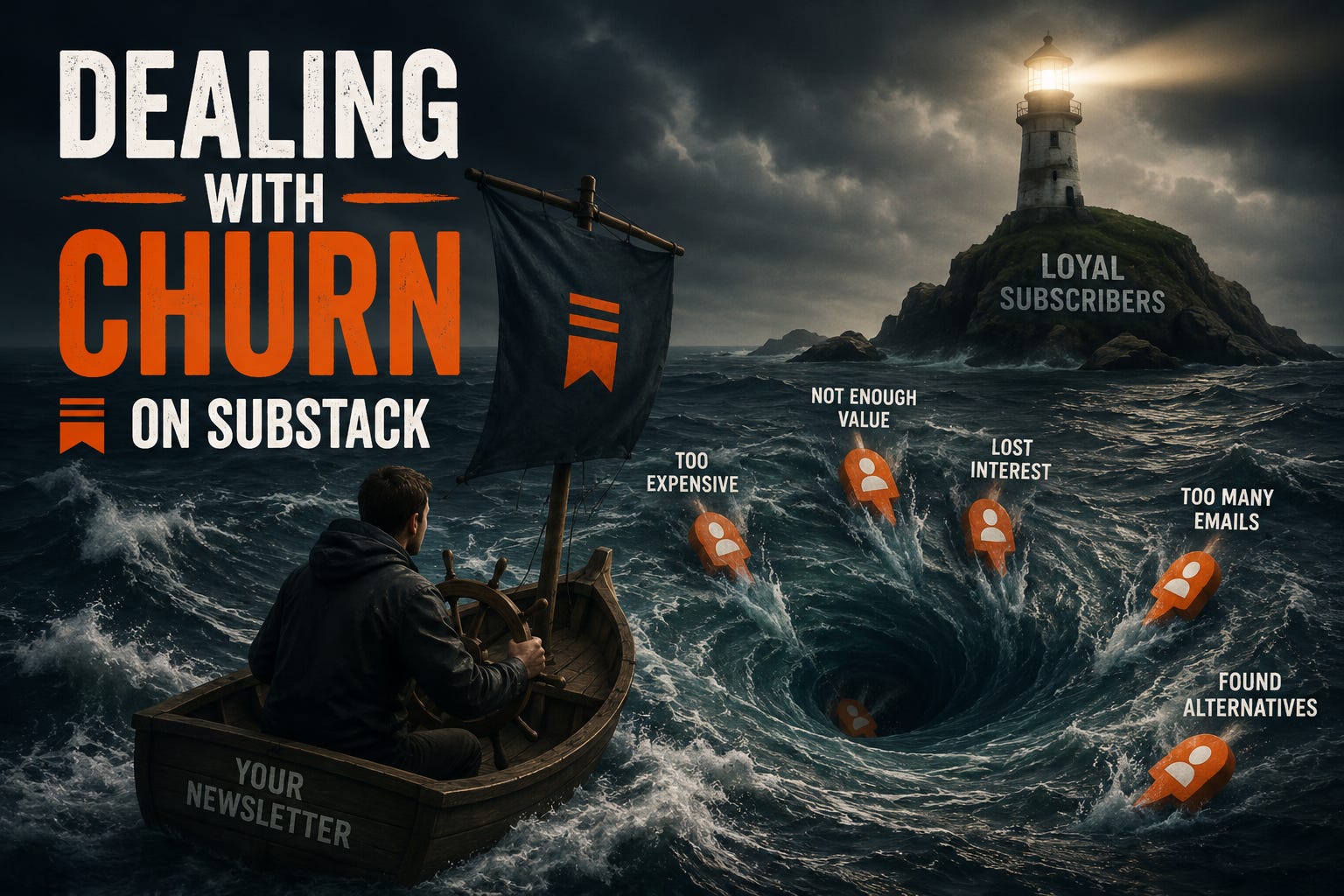
Churn simply means that a Paid subscriber unsubscribed. For whatever reason, the Paid subscriber decided that it didn’t want or need to continue renewing the Paid subscription to your Substack.
Here’s the potential impact: Let’s say you have 50 paid subscribers at $75 annual and you’re losing 3 per month. That’s $225 in lost revenue every month. $2,700 per year. But the financial hit isn’t even the most expensive part.
Think about what it cost you to acquire those 3 subscribers in the first place. The weeks of content that built the relationship. The Notes that landed at the right moment. The personal engagement that made them feel seen. The CTA that finally earned the click. The time you spent onboarding them.
None of that time comes back when they churn. And now you have to spend it all over again, just to stay in the same place.
The acquisition cost of a new paid subscriber, measured in time and energy, is significantly higher than the retention cost of keeping an existing one. Which means every subscriber you retain is worth more than the revenue they represent. They’re worth the effort you didn’t have to spend replacing them.
Churn is a leaking bucket. You can keep pouring water in from the top, but until you find the holes, you’ll never fill it.
Why Substack Paid Subscribers Churn
Before you can fix your churn, you need to understand why it happens in the first place. From everything I’ve observed, in my own publication and in working with Backstage Pass members, Substack paid subscribers typically churn for one of five reasons.
The paid content didn’t feel meaningfully different from the free content. The subscriber upgraded expecting something more, deeper access, more personal connection, exclusive content, and what they found felt like a continuation of what they already had. The value gap between free and paid wasn’t clear enough.
They upgraded on impulse and the value didn’t feel real afterward. A compelling CTA or a limited-time offer moved them to act, but in the days after upgrading they couldn’t point to something concrete that justified the decision. Buyer’s remorse set in quietly.
They felt no personal connection after upgrading. This is the most common reason I see. The subscriber upgraded expecting a relationship and found a content library. Nobody reached out. Nobody acknowledged them. The experience of being a Paid subscriber felt identical to being a free subscriber, just more expensive.
The onboarding was nonexistent. They upgraded and received either a generic Substack confirmation email or nothing meaningful at all. They didn’t know what they had access to, how to use it, or what to do next. Confusion leads to disengagement and disengagement leads to cancellation.
Life got in the way. Sometimes churn has nothing to do with you. Financial pressure, a change in circumstances, a competing priority. This type of churn is harder to prevent, but even here, a strong personal relationship dramatically increases the likelihood that a subscriber will pause rather than cancel, or return after their situation changes.
Understanding which of these is driving your churn tells you exactly where to intervene. The fix for “no personal connection” looks completely different from the fix for “content didn’t feel different.” Diagnose before you prescribe.
What a SaaS Company Taught Me About Timing
Several years ago I worked with a SaaS company on a subscriber behavior analysis project. Part of that project focused on churn, specifically, understanding when it happened and why.
A big part of our analysis was to determine when the churn happened. We discovered that the average subscriber who churned left at roughly the 3 month mark.
So in theory, if a subscriber stayed past that 3-month threshold, they would likely stay.
But we still needed to understand why subscribers would churn. We needed to discover their behavior.
At first it was puzzling, because the company had a rapid-fire onboarding sequence for new subscribers. They were given a ton of instruction and information on how to get the best out of their subscription.
Yet, they still left. The company started interviewing subscribers, and that’s when everything fell into place.
What subscribers said was the amount of information they received simply overwhelmed them, especially at first. They were flooded with instruction that they weren’t ready to process. At first they simply needed some time with the tool itself. Then after a month or so, they were ready for some hands-on help…and that’s the point at which the outreach stopped.
So the company incorporated this feedback and shifted. They lightened the load at first, and spread it out over the first 6 weeks or so, instead of overloading new subscribers in the first week or so.
The lesson: timing matters as much as content. The right intervention at the wrong moment can accelerate churn instead of preventing it. The right intervention at the right moment changes the entire trajectory of the relationship.
I didn’t fully understand how directly this applied to my own Substack until December of last year.
How Churn Happened at Backstage Pass — and What I Did About It
Up until January, I didn’t have any type of strategy to handle subscriber churn. Mainly because, up until December of last year, I had never had a Paid subscriber churn.
Three churned in December, and then another three in January.
That was too much, I knew I had to do something.
I started by studying subscriber behavior. The 6 subscribers who churned all had one thing in common: Each of them left a week or so after signing up.
That’s when it hit me: I wasn’t doing anything to reach out to and connect with them during the first 7-10 days after they upgraded to Paid.
So I created a strategy to welcome new Paid subscribers.
I customized the welcome email they get when upgrading.
Next, I DM each new Paid subscriber to welcome them and let them know what their Paid subscription includes and how I can help them.
The third part was the best: I set aside every Monday and Friday/Saturday to review the profiles of each and every Paid subscriber. This gives me a way to stay up to date with what each Paid subscriber is doing. I can review everyone’s content, engage where I can, comment or restack, etc. I can also see who is growing by tracking how many subscribers they have added since the previous time I reviewed their feed. And if someone isn’t very active, I can DM them and ask if they need any specific help.
All of this together helped address the issue I was facing of not directly engaging with new Paid subscribers as soon as they signed up.
As soon as I started taking the above steps, the number of Paid subscribers who churn fell sharply. Since January I’ve had 2 subscribers churn. Prior, I was averaging 3 a month.
That discovery, that every subscriber who churned had left within the first seven to ten days, changed everything about how I approach new Paid subscribers.
I built a three-part system to address it directly. And since implementing it in January, my churn has dropped by 85%.
The system is below, along with a five-step framework you can implement this week on your own Substack.
Upgrade to Paid to keep reading.
And through the end of May, every new Paid subscriber also receives a free copy of The 5% Conversion System, my 47-page guide covering everything I’ve done to grow from 0.5% to 5% conversion rate in 8 months, including a full section on reducing churn.
One upgrade. Two resources. Both focused on the same goal: building a Substack that grows and keeps the subscribers you work hard to earn.